Gulf · UAE Digital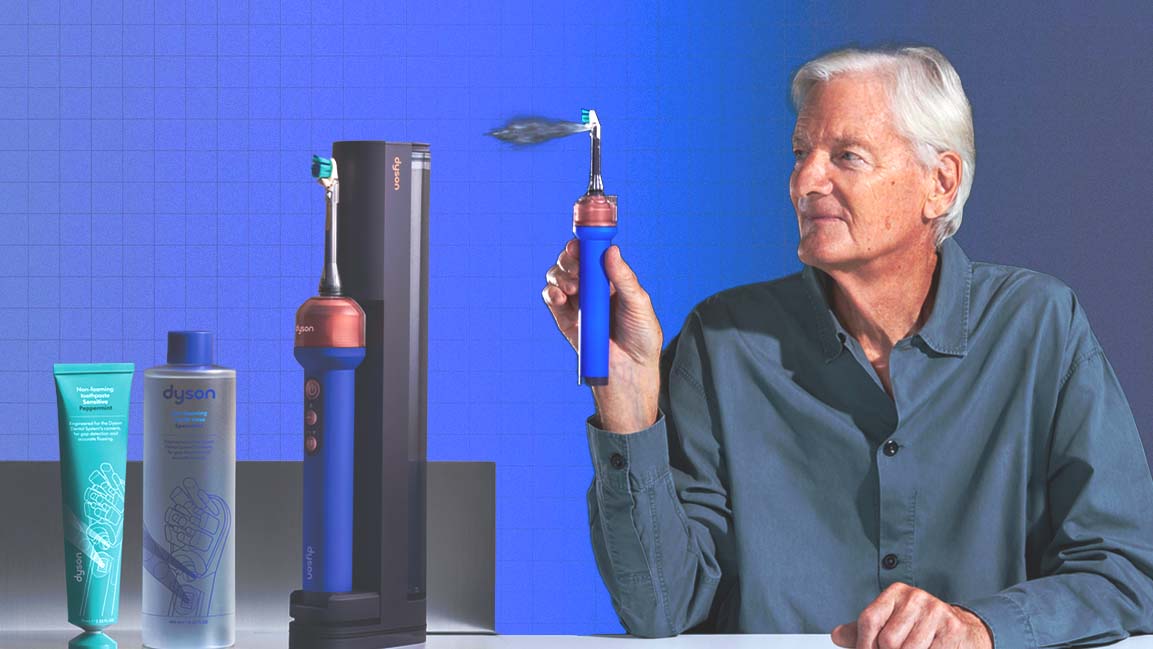
Inside the head of Dyson’s new toothbrush sits a camera about a millimeter across. It captures 28 images a second, hunting for the gaps between your teeth through toothpaste foam, saliva, and near-total darkness. When it finds one, the device has 100 milliseconds to fire a cone of mouthrinse into it.
Then it moves on and does it again. Fast Company Middle East was the first publication in the region invited to Dyson’s Singapore headquarters to see the CameraJet before its launch. The company says it could not buy a camera small enough for the task off the shelf.
“These are not cameras that can be bought off the open market, so creating that 1 mm camera was something we had to originate,” said Kathleen Pierce, then Dyson’s global president for beauty. CameraJet is Dyson’s first oral-care product. Its novelty isn’t the combination of brushing and water flossing; Waterpik already offers that.
It is the use of a camera and a machine-learning system to identify each gap and automatically trigger the jet. Dyson says the project spanned six years, involved 661 engineers, produced 38 patents and 16 million lines of code, and relied on a model trained on 470,000 dental images. On the evidence of two long conversations with the people who built it, CameraJet is less a story about brushing than about what happens when an industry stops improving its own products.
DYSON’S ARGUMENT Dyson believes the category left room for a new entrant because it had stopped meaningfully evolving. Its case starts with a vacuum cleaner. Dyson frames the argument through the DC01.
When James Dyson developed the vacuum cleaner, the company says, incumbents had little reason to improve the hardware because recurring revenue came from replacement bags. Dyson sees oral care similarly: competitors make their money from replacement brush heads, not handles. To test that theory, Dyson gathered competitor brushes priced from $25 to $250 and found the underlying technology broadly similar across the range.
In the company’s view, the category follows a familiar pattern: a launch, a modest increase in specifications, and then a discount. Dyson estimates that devices priced above roughly $200 account for less than 3% of the category, with most products selling for less than $100. The company cites the Supersonic hair dryer as a precedent: it entered a low-priced category in 2016 and helped turn beauty into what Dyson describes as one of its strongest growth engines.
Dyson is privately held and does not disclose divisional figures, so that claim cannot be independently checked. A SMALLER TANK FORCED EVERY OTHER DECISION The engineering story begins with a constraint rather than an ambition. Niamh Turney, now a senior commercial manager at Dyson, joined through the first cohort of the Dyson Institute as an engineer and worked on the product.
She explains that the founding problem was fitting a water flosser inside a toothbrush. “Ordinarily, a tank on a flosser is about 300 ml, so roughly a Coca-Cola can. And they fire continuously, and not only does that flood your mouth, but there’s no guarantee that you’re going to hit the gap.” Shrinking the tank to fit in a handheld device meant the jet could no longer fire continuously.
It had to fire only when it mattered. “We could only afford for the tank to disperse once it sees a gap. So we had to develop gap detection.” That requirement produced the camera, the machine-learning system reading its output, and a 12.5 ml tank, which Dyson says is the recommended dose of mouthrinse for one session.
A single constraint generated the entire architecture. Then user testing produced another. People clean the backs of their teeth with the brush held horizontally, and a conventional reservoir draws in air when tilted.
“The traditional straw in a cup fell short,” Turney says. The answer was an anti-gravity tank built around a flexible closed-transfer chamber that expands during use to eliminate air pockets, so the jet fires at any angle rather than, as the company puts it, firing blanks. Dyson also rejected the jet shape used by conventional water flossers it tested.
In the test setup, the company says, the narrow, needle-type jets used by those devices punctured plaque rather than removing it. Its conical jet sweeps a wider area at lower pressure, which Dyson says lifts more plaque while being gentler on gums and enamel. THEY HAD TO INVENT FAKE PLAQUE FIRST None of that could be measured without something to measure it against.
The project exposed the lack of a repeatable material Dyson could use for in-house testing. “First and foremost, I’m not a dentist, so I had to learn a lot about teeth, mouth, gums and plaque,” Turney says. Through a five-year collaboration with the National University of Singapore’s Faculty of Dentistry, Dyson developed a proxy plaque: a synthetic stand-in with the mechanical and chemical properties of the real thing.
Engineers could use it in-house without commissioning a clinical trial every time they changed a variable. The work also corrected Turney’s assumption that plaque was a hard substance. Plaque is a sticky bacterial biofilm that forms on teeth.
If it isn’t removed, some of it can mineralize into calculus (tartar), which requires professional cleaning. CameraJet’s premise is to make cleaning between teeth easier before that happens. The Singapore labs handle the rest.
A laser rig tracks brush head movement to within microns. A vision rig simulates the foam, saliva, and darkness the camera must survive. Dyson says high-speed cameras of the sort used in film production showed that competitor bristles stall against the tooth surface, a finding that produced its variable sonic oscillation.
In the verification lab, robotic rigs run around the clock to compress years of use into days. All of it is Dyson’s own testing, run in its laboratories against a proxy developed under a funded collaboration with NUS. It establishes controlled performance rather than real-world clinical outcomes.
The user trial clinic did something less glamorous and more useful: it caught what engineers had got wrong about people. A maintenance solution developed in the lab proved impractical when real users tried it. “What started as a lab-based problem became a co-designed solution, shaped directly by observing real user behaviors,” says Kevin Chuah, lead design engineer.
Alessandra Pennetta, senior manager for global clinical affairs, puts it plainly: “People don’t always use products the way engineers expect them to.” THE HARDEST PROBLEM ISN’T THE HARDWARE In March 2025, the World Health Organization estimated that oral diseases affect nearly 3.7 billion people. But the problem CameraJet is designed to address is more specific: people routinely fail to clean between their teeth, where brushing alone can fall short. Compliance, in other words, is the category’s real problem, and it is behavioral.
Dyson’s pitch is that CameraJet could reduce the burden by integrating brushing and water flossing into one routine. Users still turn on a brush, add toothpaste, and begin; the device is meant to find the gaps and fire the jet without requiring a separate flossing step. The independent evidence is more equivocal than the pitch.
A 2019 Cochrane review of 35 trials covering 3,929 adults found that cleaning between the teeth in addition to brushing may reduce gingivitis and plaque, but rated the certainty of that evidence low to very low, noted the trials mostly ran only one to three months, and cautioned that the effect sizes may not be clinically important. Separate trials of water flossers have found that people comply with them more readily than with string floss, while clinical outcomes are broadly comparable. That pattern cuts both ways for Dyson.
It supports the argument that convenience drives adherence and undercuts any suggestion that a jet cleans better than floss that somebody actually uses. The system extends beyond the handle. Dyson has formulated its own toothpaste without sodium lauryl sulfate, or SLS, a common foaming agent, so foam does not blind the camera.
It has also developed a low-foaming mouthrinse for the jet. Both come in Ginger Mint and Spearmint; the toothpaste adds a Peppermint Sensitive variant. Dyson has not disclosed whether those formulations are required for CameraJet to work as intended or how they will be priced.
Innovation may not eliminate repeat purchases; it may simply change what customers replenish. The camera also feeds into the MyDyson app, giving users a live close-up view inside the mouth, along with coverage mapping and technique feedback. Dyson says the camera is active only during live viewing or automatic jetting.
The company says no images are recorded or stored on the device or in the cloud, and that the live images remain private to the user. WHERE THE GULF FITS In the Gulf, the immediate test is distribution. Dyson already reaches premium beauty channels in the region.
The distribution strategy is more revealing. Ahead of the September 2026 launch, Dyson estimated that 80% to 85% of its global distribution already overlapped with oral-care retail. The remainder is the opportunity: placing CameraJet in beauty retailers such as Sephora, which do not traditionally sell toothbrushes, to reach new customers.
Placing the launch under Dyson’s beauty division signaled the intended positioning: oral care as beauty and wellness technology, not only dental hardware, sold through channels where those products already perform. THE PIPELINE IS THE POINT Dyson is not treating CameraJet as a single launch. The company says it has announced a second product, Lightbeam, expected less than six months after CameraJet’s launch.
That timing matters. Dyson is presenting CameraJet as the start of a category rather than a one-off experiment. Turney says the team is already working beyond the first launch: “We’re never satisfied.
We’re always going to be innovating.” Dyson’s stated test for entering a category is simple: the product must work, deliver something the market has not seen, and do what it promises. CameraJet’s laboratory performance answers two of those questions. The Singapore laboratory can show whether CameraJet detects gaps and fires accurately under controlled conditions.
Whether it improves daily oral care and creates a viable premium category will be decided in bathrooms by people who have spent years avoiding floss. Dyson had not announced pricing or availability in the Middle East at the time of publication.
Source: Fast Company Middle East